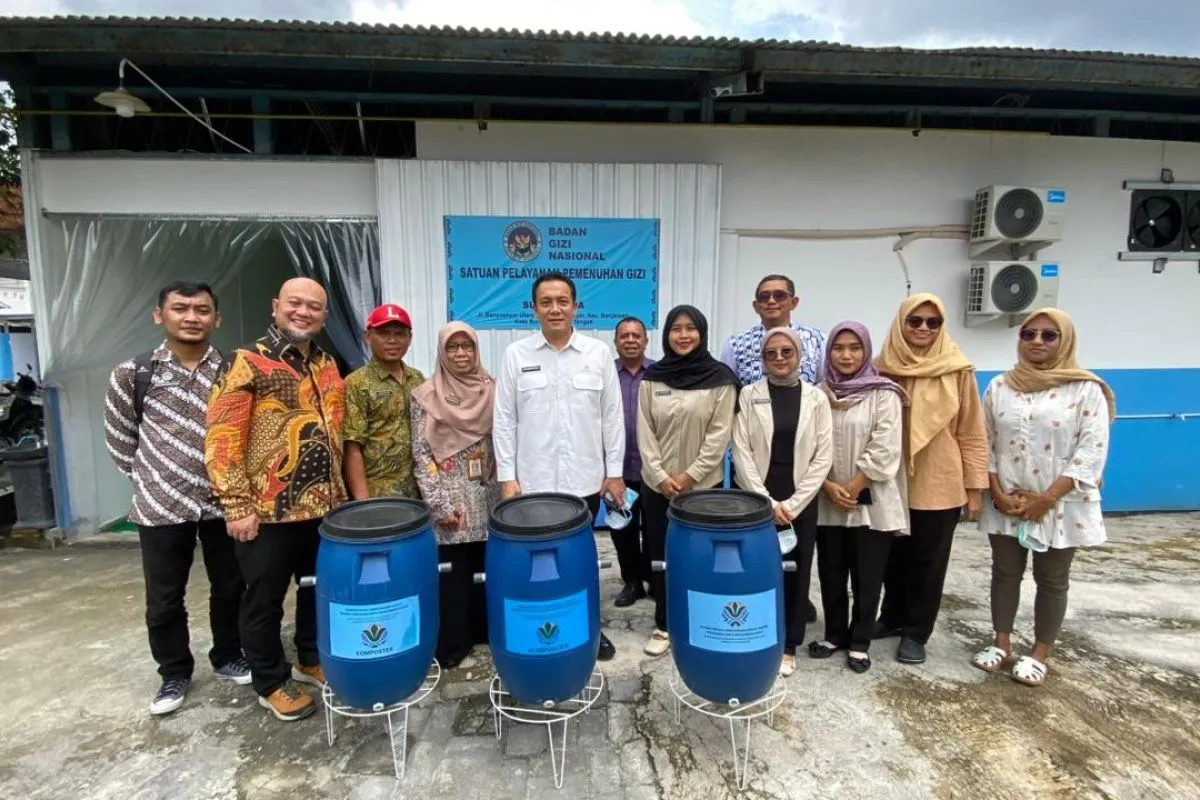
Jakarta (ANTARA) - Deputy Minister of Environment Diaz Hendropriyono asserted that the Free Nutritious Meals (MBG) program must be accompanied by pollution mitigation, food waste management, and environmental protection measures."The Ministry of Environment seeks to ensure that this program can provide the best nutrition to all the nation's children without harming the environment," he said in a statement on Friday.
The statement followed his monitoring of two nutritional fulfillment service units (SPPGs), or MBG kitchens—Banyuanyar SPPG and Busukan SPPG—in Surakarta, Central Java, on Thursday.
On that occasion, he handed over three composter units to each of the two SPPGs to support more effective organic waste management.
At the Banyuanyar SPPG, which serves more than 3,000 beneficiaries, the deputy minister expressed appreciation for the comprehensive liquid waste and organic waste management systems already in place, including the recycling of used cooking oil.
Regarding the environmental issues previously raised by local residents, the SPPG management demonstrated a prompt and effective response by constructing a wastewater treatment plant.
This facility is equipped with grease traps, infiltration ponds, aerobic and anaerobic treatment tanks, and mechanical filters.
Baca juga: Sebanyak 4.000 guru di Mataram terima MBG
At the Busukan SPPG, which serves around 3,100 beneficiaries, Hendropriyono inspected facilities equipped with grease traps and organic waste processing systems.
However, for liquid waste management, the Busukan SPPG currently relies on city government facilities. As a form of support, the composters were provided to further strengthen upstream waste management.
Baca juga: Menko Airlangga sebut Rp335 triliun disiapkan untuk MBG di 2026
He reaffirmed that the Ministry of Environment remains committed to ensuring that every SPPG follows uniform environmental management standards to achieve a zero-waste concept within the program.
The MBG program was launched by the Indonesian government on January 6, 2025, as one of the priority programs of President Prabowo Subianto, aimed at improving the nutritional status of children under five, pregnant women, breastfeeding mothers, and schoolchildren up to the high school level.
Targeting 82.9 million beneficiaries, the program is among the largest government initiatives ever implemented in the country.
Pewarta : Prisca Triferna, Raka Adji
Editor:
I Komang Suparta
COPYRIGHT © ANTARA 2026


